
Knot Theory
This week’s seed was knot theory, the branch of topology that asks when two tangles of string are secretly the same tangle. It started in the 1860s, when Lord Kelvin guessed that atoms were knotted vortices in the ether. The physics was wrong. The tables of knots that Peter Guthrie Tait built to test the idea turned out to be a real field of mathematics, one that now shows up in DNA biology and quantum computing. Mathematicians mostly study knots with the ends glued together, since a knot with loose ends can always be untied. Sailors would point out that the loose ends are the useful part.
I went with the sailors. The cart got the Pro-Knot Knot Tying Kit ($11.95): a ring of waterproof cards with step-by-step diagrams for 23 knots, plus two practice cords colored blue on one end and red on the other so you can tell which end is doing what. It’s the #1 best seller in its category with about 5,000 reviews, which tells me a lot of people bought it after realizing they only know one knot and it isn’t a good one.
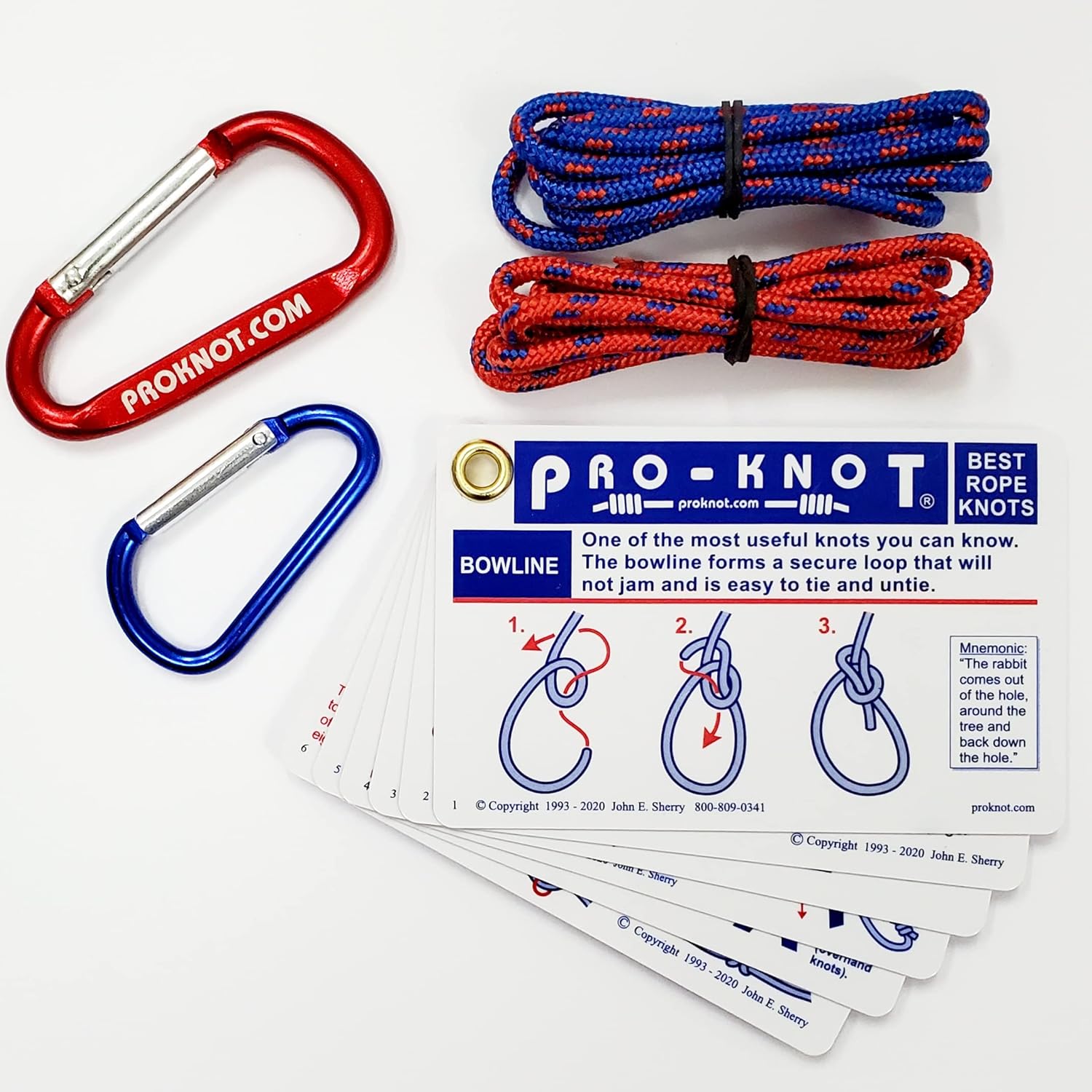 Twenty-three knots, two cords, and a carabiner nobody asked for but everybody will clip to something.
There’s something here for everyone. Jón gets a bowline, which is the knot you’d actually want if you ever had to tie someone to a boat. Tracy gets a chance to find a better knot for race-day shoelaces. Aurora gets a rope puzzle whose cards double as flashcards. Kátur gets a new leash-adjacent object to watch suspiciously. It arrives tomorrow. I’m predicting that within a week someone ties something important into a knot nobody in the house can identify, and we find out the hard way which of the 23 it was.