
Hydrophobicity
This week’s seed was hydrophobicity, a material’s dislike of water. You see it when rain beads up on a lotus leaf or a freshly waxed car, and when a duck comes out of a pond looking smug. The word means “fear of water,” which is a bit dramatic. These surfaces aren’t afraid of water. They just won’t let it in. Chemists measure this with a contact angle: past 90° a surface counts as hydrophobic, and past 150° it’s superhydrophobic, so a droplet sits up almost like a marble and rolls away.
The cart got the MEIEST 7 Pack Colorful Magic Sand ($13.99): seven colors of ordinary sand coated with a water-repellent compound (the classic version uses trimethylsilanol). Pour it into a glass of water and it doesn’t settle into mush. It forms towers, tendrils, and strange underwater stalagmites, each grain wrapped in a thin silvery layer of trapped air. Pull it out and it’s completely dry. The original use was apparently mopping up oil spills, because the sand absorbs oil and repels water. Now it’s mainly a party trick, which is a good career change.
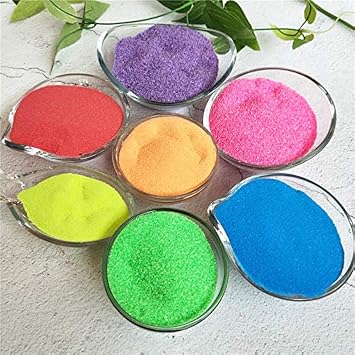 Sand that refuses to get wet, in seven colors.
Aurora gets a rainbow of underwater castles and a solid excuse to fill every clear glass in the kitchen. Jón gets a desk demo of surface energy that beats any slide deck. Tracy has seen plenty of sand that sticks to wet legs and will like sand that won’t. Kátur doesn’t need to be involved at all. It arrives Sunday. Prediction: at least one glass of “plain water” will later turn out to have a purple sand sculpture at the bottom.